



FR - Part of the Rouergue Bastides and Abbeys Route, Villefranche-de-Rouergue holds the ‘Grand Site d’Occitanie’ designation and, since 1992, that of a Ville d'Art et d'Histoire (Town of Art and History), alongside the ‘Rouergue Bastides Region’.
Together with its unmissable historic centre and its collegiate church (1252, listed as a Historic Monument since 1892), visitors can also admire the Saint-Sauveur Charterhouse, just a few minutes’ drive away, whose cloister ranks among the largest in France.
|
Did you know? It was not until 1919 that ‘de Rouergue’ was added to the town’s official name.
|

Bastides and the Gorges de l’AveyronAmong the town’s other notable monuments are the Maison Combettes and its 16th-century square tower, the Maison Gaubert, Place Notre-Dame (listed since 1996) and its superb medieval arcades, and the old bridge, or Pont des Consuls, which has spanned the Aveyron since the 14th century…
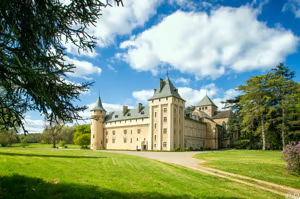
Less than 3 km from Villefranche-de-Rouergue stands the Château de Graves (1543, listed since 1991).
Set in the centre of an estate covering several hectares, the ‘quadrangular château’ is built ‘around a perfectly square courtyard measuring 12 metres on each side, featuring Tuscan-style decoration, flanked by towers, and lacking any defensive features’ (source).
|
A bit of history: Villefranche-de-Rouergue traces its origins back to 1099 and the decision by Count Raymond de Saint-Gilles to establish the first settlement on the left bank of the Aveyron. It was not until the reign of Alphonse de Poitiers, brother of King Saint Louis, that the town moved to the right bank, a few kilometres from the original settlement. Jean des Arcis, Seneschal of Rouergue and founder of the new town, then adopted the grid-plan architecture of ancient Rome (source)...
|
Focus on the Chartreuse Saint-Sauveur
A national property since 1790 and listed as a Historic Monument in 1840, this former monastery of hermit monks of the Carthusian Order stands as a living testament to monastic life. From the church with its luminous stained-glass windows to the large and small cloisters, from the reading pulpit in the refectory – ‘built entirely within the thickness of the wall’ – to the tabula cet – ‘an astonishing 17th-century painted wooden panel that served as a timetable for the monks’ – and a visit to the chapel of strangers with its beautiful wooden stalls, the Carthusian monastery is sure to leave a lasting impression.
|
Did you know? Carthusian monasteries always have two cloisters: A small one at the heart of the communal buildings and a large one leading to the cells...
|
Although the audio guide chapters are available online (such as The Courtyard of Obediences, The Vestibule or The Small Cloister), nothing beats a visit in person, combining contemplation with a sightseeing stroll.
|
The Route of the Bastides and Abbeys of Rouergue? We also meet pilgrims on the Way of St James who are following the Via Podiensis, that is, the Le Puy route (GR 65; further information is available on the website of the Bas Rouergue to Compostela association or on the website dedicated to the St James routes via Villefranche-de-Rouergue).
|
 Focus on the Cistercian Abbey of Loc-Dieu
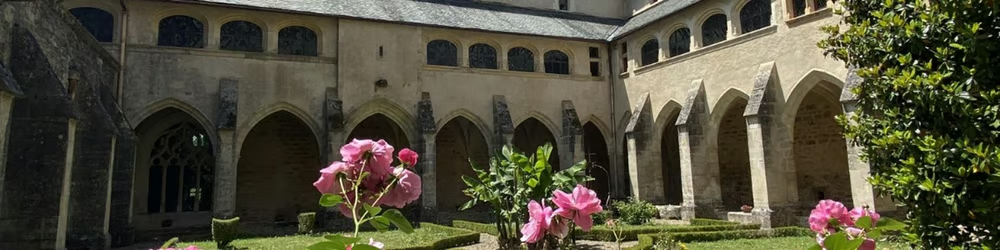
Located 11 km from Villefranche-de-Rouergue, Loc-Dieu Abbey, the oldest Cistercian abbey in the Rouergue region and listed as a Historic Monument since 1989, lies on the Way of St James. Dating back to the 12th century, it boasts a magnificent park covering over 40 hectares, which reflects the origins of its name. Indeed, ‘why “Loc Dieu”?’ Originally, the large, dense woods of Loc Dieu, exceptional in this region of limestone plateaus, served as a hideout for bandits who attacked travellers on the Roman roads between Rodez and Cahors or Rodez and Montauban. At first, these woods were nicknamed locus diaboli: ‘the devil’s place’. Then, when the abbey was consecrated, its name was changed to locus dei: ‘the place of God’, which later became ‘Loc Dieu’ (Abbey of Loc Dieu). With its abbey church, blending the Romanesque style of its early days (1159) with the Gothic style of its completion (1189), its splendid Gothic cloister—ideal for contemplation and rebuilt in the 15th century—and its monastic buildings giving it the appearance of a fortified castle, Loc-Dieu Abbey will delight history lovers. Did you know? Loc-Dieu Abbey is a member of the European Charter of Cistercian Abbeys and Sites, which since 1988 has brought together ‘owners and managers of Cistercian abbeys, including those housing Cistercian communities, and the association La Demeure Historique, which “represents and supports heritage stakeholders—namely the owners and managers of private historic monuments and gardens—in their public-interest mission of preservation and transmission”’ (Visuals©Abbaye de Loc-Dieu).
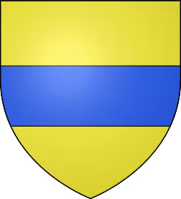 Village and castle of Belcastel
As one of the Most Beautiful Villages in France, Belcastel stands as a tribute to the region’s splendid slate roofs.
The castle, which overlooks the village from its rocky outcrop, and the old bridge have been listed as Historic Monuments since 1928, a distinction they richly deserve given their heritage value. The castle, in particular, was passionately restored from 1974 onwards by numerous craftsmen specialising in heritage and the architect and urban planner Fernand Pouillon, who, despite having spent many years working on the reconstruction of post-war France (the old port of Marseille, Aix-en-Provence), devoted himself to this project towards the end of his career. Not to be missed, of course, is the castle’s keep, which ‘houses a permanent exhibition dedicated to the creatures of the medieval bestiary, as well as a temporary programme that changes regularly. The network of cobbled streets takes visitors on a journey through time and space, right up to the drawbridge that leads to the castle… and the dragons!’.
The right address: Villefranche-de-Rouergue, Source : bastides-gorges-aveyron.fr.
Chartreuse Saint-Sauveur, Avenue Vézian Valette, 12200 Villefranche-de-Rouergue, Tel: 05 36 16 20 00, 05 65 45 55 58, contact@bastides-gorges-aveyron.fr. Opening hours. Find Chartreuse Saint-Sauveur on Instagram.
Fortified Abbey of Loc Dieu, 854 route de Loc Dieu, 12200 Martiel. Open Wednesday to Saturday and Sunday afternoons in April and October from 10 am to 12 pm and from 2 pm to 5.30 pm; Wednesday to Saturday and Sunday afternoons in May, June and September from 10 am to 12 pm and from 2 pm to 6 pm, Tuesday to Friday and Sunday afternoons, in July and August from 10 am to 6 pm. Find Loc Dieu Abbey on Instagram. Thanks to Loc Dieu Abbey for the images provided.
Château de Belcastel, 12390 Belcastel. Open: The Château is open from 14 March to 11 November; in high season (15 June–15 September) from 10 am to 7 pm; in low season (14 March–31 March) from 10 am to 12.30 pm and from 2 pm to 5.30 pm; at weekends from 10 am to 1 pm and 2 pm to 6 pm; from 1 April to 14 June, and from 16 September to 11 November from 10 am to 1 pm and 2 pm to 6 pm. Find the château on Instagram.
Château de Graves, 37 Côte de Graves, 12200 Villefranche-de-Rouergue. Open from 1 January to 31 December, Monday to Friday from 9 am to 12 pm. Tel: 06 74 65 29 93.