
FR - This winter, don't boost your immunity, modulate it with an anti-virus kit!
Follow the advice of Maud Simonelli, our health partner, to have a great winter season, from Xmas holidays until the end of March.

Sculpture, peinture, gravure, Trois artistes, trois histoires... en un clic !

Les Geiq, l'action des employeurs pour l'insertion... en un clic !

Les abricots... en un clic !

Le printemps en Uzège...

Séjourner au Domaine de Gressac... en un clic !

Virée à vélo et à pied sur le littoral occitan... en un clic !


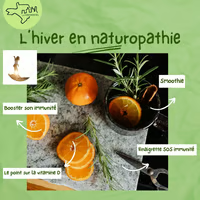
Good habits to support the immune system
The first step in supporting your immune system is to ensure you are getting enough essential nutrients, vitamins A, B6, B9, C, D and E, minerals and trace elements such as zinc, selenium and iron, omega-3 polyunsaturated fatty acids, proteins, polyphenols and carotenoids.
Tip: Prepare ‘rainbow’ plates by eating vegetables of all colours every day.
On the menu
Vitamin C from seven plants: acerola, rosehip, sea buckthorn (juice, syrup, compote), elderberry, camu camu (powder), aronia (dried), and açai (frozen pulp).
When it comes to food, we should also think about kiwi fruit and parsley, of course!
Plant-based iron, a pillar for a strong winter
It plays a role in the proliferation of immune cells and the regulation of innate and adaptive immunity. Consider spirulina in different doses depending on weight: 1g/day for those under 20kg, 2g/day for those between 20 and 40kg, 3g/day for those between 40 and 60kg, and 4g/day for those over 60kg, for 6 to 12 weeks.
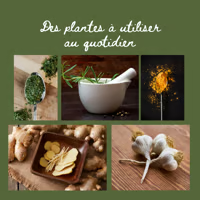
Plants for everyday use without excess
Thyme and rosemary, the winning combination. Use as herbs in cooking or in the form of infusions, decoctions, syrups or glycerine macerates of young shoots in gemmotherapy, 5 days out of 7 and 3 weeks out of 4, with dosages adapted to age.
Garlic and onions, sulphur that makes microbes sweat. Note: If we do not consume FODMAPs (particularly in cases of irritable bowel syndrome), we can still enjoy the benefits of the sulphur molecules in these aromatic vegetables without ingesting their fibre. To do this, prepare an oil infused with garlic and onion by simply macerating them finely chopped in a carefully chosen oil (walnut, flaxseed, etc.).
Let's incorporate turmeric and ginger (or their cousins galangal and zérubette) fresh or powdered into our dishes, or let's start a ‘golden latte’ routine (a glass of plant-based milk + 1 teaspoon of turmeric powder + 1 teaspoon of ginger powder).
And let's not forget other spices: cinnamon, cloves, cardamom, star anise, etc.
Medicinal mushrooms: not to be underestimated
Reishi is particularly interesting for its anti-inflammatory effects in cases of autoimmune diseases, sleep disorders or anxiety and depression.
Lion's mane is useful for intestinal permeability and dysbiosis issues, as well as cognitive disorders (brain fog, learning difficulties, etc.).
Cordyceps is ideal for cases of extreme fatigue, burnout, convalescence, athletes, low libido, etc.
Sun mushroom can be beneficial for people with allergies, food intolerances or insulin-glucose metabolism disorders.
There are also shiitake, maitake, and other varieties.
The latest on vitamin D
Today, we see many cases of vitamin D deficiency. It is difficult to achieve optimal levels without supplementation (the optimal level is 50-60 ng/ml in the blood, or even higher in cases of specific pathologies).
It is also necessary to have an optimal level of vitamin A at the same time. The maintenance doses (i.e. to maintain an already good level) currently recommended are 4000 IU per day. In the event of a deficiency, it is necessary to increase these doses until the correct level for your personal situation is reached, under the supervision of a health professional, of course.
The ‘ampoule’ form, to be taken every 2 or 3 months, is less beneficial from a physiological point of view than daily intake (capsules or drops). As vitamin D is fat-soluble, these supplements should be taken with a meal and especially not on an empty stomach.
SOS immunity salad dressing
A recipe to treasure: the salad dressing that boosts immunity!
1 tablespoon of unfiltered and unpasteurised cider vinegar, 3 tablespoons of garlic and onion infused oil, 1 tablespoon of sheep's yoghurt, 3 drops of organic lemon essential oil, 1 tablespoon of chopped fresh parsley, salt and pepper to taste.
The anti-cold tip according to traditional Chinese medicine: use this dressing on cooked, warm vegetables (carrots, potatoes, green beans, etc.) rather than on a fresh salad.

Morning smoothie
A recipe that is both delicious & perfect for coping with the autumn and winter chill:
Blend the juice of 2 home-pressed organic oranges (or another citrus fruit), add 1 tablespoon of honey (chestnut or fir), 1 kiwi and 1 handful of frozen red berries.
You can add 1 handful of fresh spinach leaves if your diet is otherwise unbalanced and/or 1 tablespoon of barley or wheatgrass powder if you have microbiota issues.
Homemade grog for the throat
This grog will help you overcome minor colds and chills:
Make an infusion with 1 level teaspoon of thyme (or wild thyme for children under 4), 1/2 organic lemon, 3 cloves, 1/2 teaspoon of cinnamon, 1 teaspoon of fresh grated ginger in a cup of water, covered for 15 minutes.
Strain and add 1 tablespoon of honey.
Drink the grog 2 to 3 times a day for 4 to 5 days.
Good to know: If necessary, you can supplement the grog by spraying Roman chamomile hydrosol (kept in the fridge) into your throat 4 to 5 times a day or gargling with propolis (10 drops in a glass of water) twice a day (or alternating between the two).
Many thanks to Maud Simonelli, from Equilibre et Vous, for her contribution to the Health section of the blog.