



FR – Drawing inspiration from numbers, numerology is said to stem from gematria, which is based on Hebrew numerology (where letters have numerical values), although ‘some experts attribute its origins to Chinese and Hindu civilisations’… or perhaps it ‘is the work of the famous Greek mathematician Pythagoras’.
|
According to Pythagoras, ‘Numbers govern the Universe. Everything is arranged according to Number’.
Pythagoras, once again, attributed a symbol to each number as far back as antiquity:
The number 1 symbolises the Creator, the perfect being, the Divine.
The number 2 embodies duality: the feminine and the masculine, good and evil.
The number 3 is synonymous with the principle of the Trinity, comprising light, spirit and the Word.
The number 4 evokes the four elements: water, air, earth and fire.
The number 5 symbolises physical pleasures and procreation.
The number 6 embodies the trials to be overcome, the earthly obligations that weigh upon a person.
The number 7 is the perfect number par excellence, a symbol of beauty and the sacred.
The number 8 evokes balance and justice.
The number 9 marks the end of the cycle, the transition to a new beginning (Numerology: The Wisdom of Numbers).
|
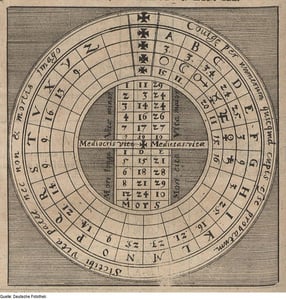
 Agrippan numerology tableIn any case, this art, which undoubtedly originated ‘around 5,000 years ago’, aims to interpret an individual’s personality and destiny by linking numbers (date of birth) to letters of the alphabet (first name, surname).
By the 20th century, ‘in the Anglo-Saxon countries, and more particularly in the United States and then in Europe’… numerology very quickly ‘established itself as a divinatory art and gained recognition’. In 1905, The Power in Numbers was published by the American writer and lecturer Sarah Joanna Dennis, regarded as the founder of modern Western numerology, who went on to publish another book, The Philosophy of Numbers: Their Tones and Colour, in 1908.
|
‘In In the Bible, there are also numerous references to numbers,
which are cited as symbols of God’s manifestations. Writers such as Victor Hugo,
Honoré de Balzac and Paul Claudel took a keen interest in their metaphorical significance.
As for the divinatory arts, many attach great importance to numbers,
such as the Tarot of Marseille and, as we shall see later, cleromancy ’ (Numerology, the wisdom of numbers).
|
Discovering numerology
Hello Delphine,
Following on from singing bowls, we’re back with you to discuss numerology. Could you give us an overview of numerology?
Following on from singing bowls, numerology does indeed now play a significant role in my work. More specifically, I practise Strategic Numerology®, an approach to self-knowledge developed by Lydie Castells.
Contrary to the image people sometimes have of numerology, it is not a divinatory art or a form of fortune-telling. It is a method based on the numbers derived from our date of birth, all our first names and our surname. By converting letters into numbers (gematria) and using mathematical calculations, it enables us to create a personal tree and a Life Plan, unique to each individual.
The personal tree consists of eight elements (two roots, the trunk, the bark, the branches, the leaves, the fruit and the sap), each shedding particular light on the person’s personality, fundamental needs and potential. The symbolism of numbers then enables a holistic interpretation to be offered, helping one to better understand how they function, their strengths and any potential obstacles that may prevent them from living life to the full.
The analysis also includes the Life Plan, with its personal seasons and years. The aim is not to predict the future, but to gain a better understanding of the dynamics specific to each period, so that one can act with greater fluidity, discernment and effectiveness.
There are several schools of numerology, each with different origins, methods and interpretations. Strategic Numerology® stands out for its approach, which is at once structured, practical and deeply humanistic. It does not seek to predict the future, but to provide insights that enable people to make more conscious choices, navigate periods of change more effectively and realise their potential. I regard it as a genuine tool for personal development, just like singing bowls: one works through the vibrations of sound, the other through the language of numbers, but both invite us to get to know ourselves better and rediscover our inner balance.
 Who is this art intended for, and who practises it?
Strategic Numerology® is, above all, a method of self-discovery aimed at anyone who wishes to get to know themselves better, gain a deeper understanding of how they function, or is going through a period of self-reflection – whether this involves a career change, a life transition, relationship difficulties, or simply a desire to grow with greater self-awareness.
It is practised by professional numerologists certified in Strategic Numerology®. Strategic Numerology® cannot be improvised. It requires in-depth training and is taught at the School of Strategic Numerology® (EDNS), founded by Lydie Castells, the creator of the method. The course is demanding and equips students with the theoretical knowledge, analytical tools and coaching approach necessary for professional practice. Established in 2014, Strategic Numerology® is now the subject of a genuine commitment to knowledge transfer, teaching and research.
In 2021, Lydie Castells established the Institute for Consultancy, Teaching and Research in Strategic Numerology® (ICERNS®), dedicated to the training, support and development of this discipline. Since 2023, the EDNS has been the leading numerology training organisation accredited by the DREETS and Qualiopi-certified, guarantees of the rigour and quality of its teaching. It was within this framework that I undertook my training in order to offer ethical, structured and personalised support...
Read the second part of our paper on numerology in early November.
Many thanks to Delphine Acedo for her contribution to this article.
The right address: Delphine Acedo. Contact: Tel: 06 17 23 80 16. Find Delphine Acedo on Instagram.
Sources: Wikipedia, psychaanalyse.com ‘Numerology, the wisdom of numbers’.