



FR – Just as humans are fond of osteopathy, so are animals, who find in this manual and personalised approach a more natural alternative to traditional medicines for treating their ailments.
 Introduction
‘Developed in France from the early 1970s onwards by veterinary surgeon Dominique Giniaux, who practises mainly on horses’ (ioa-osteopathie.fr), veterinary osteopathy is sometimes included in the training of certain vets.
However, an increasing number of animal health professionals are choosing to devote themselves entirely to this medical practice, such as Nymphéa Protin, who has been passionate about animals since her earliest childhood and decided to retrain in this field after a career in audiovisual production.
|
A brief history: The origins of osteopathy (from the Greek osteon – bone, and pathos – suffering)
date back to the late 19th century. It was indeed at this time that the American therapist and surgeon
Andrew Taylor Still (1828–1917), observing the systematic use
of medicines that were unsuitable or poorly tolerated by patients,
introduced the practice in the United States, extolling its benefits for relieving the human body.
In 1892, he founded the first school of osteopathy in Missouri,
the American School of Osteopathy and published four books on the subject between 1898 and 1900.
|
 Let's chat
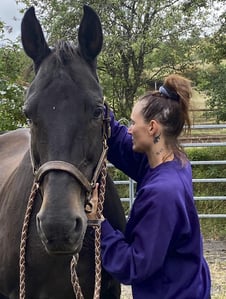
“After eight years of working freelance in the audiovisual sector, I realised that the profession was entering a new era – the digital age – and was becoming accessible to the general public, which was beginning to affect my work. So I decided to return to my childhood dream: veterinary osteopathy. Even back at secondary school, I wanted to pursue this career, but I was far from knowing all its facets, especially as, at that time, students had to go to England to undertake the training.
I undertook my training at the IFOA in Tarascon and chose not to specialise in a single species, as I particularly love the diversity that my profession offers. The richness of my encounters with animals and people, their life stories, and their views on the human–animal relationship is what makes my practice so interesting and rewarding – it shapes how I understand animals, broadens my perspective, and influences how I approach each session.”
Having practised her profession since 2020 and based in Uzès since late 2023, Nymphéa was very quickly taken to her hearts by her patients and… their humans: “Horses, dogs, cats, farm animals – they’re all welcome! I love offering them my support and 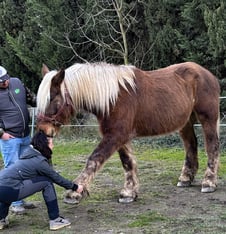 relieving them of their ailments. My approach, which is above all caring, helps to bring serenity and comfort.
I only make home visits or suggest outdoor locations in a quiet setting conducive to relaxation, where this is more convenient. I usually stay for an hour. The session itself therefore lasts less time and depends on the animal (species, age, emotional state, reason for the consultation, whether or not it is already being treated by a healthcare professional, etc.). I never look at my watch, because naturally it lasts an hour… but I do sometimes stay longer, especially if the owner needs more time to talk. I never neglect this part of the session.
The number of sessions often depends on the animal; it is the animal that guides me. Of course, an animal that is active, chronically ill, growing or ageing, for example, will require more regular follow-up. It is actually… a bit of a team effort, as each member is necessary and complementary: therapist/animal, human/animal, osteopath/human/animal. It is essential to build a genuine relationship of trust, as the environment, the emotional state of the animal and its owner, the proposed activity, and 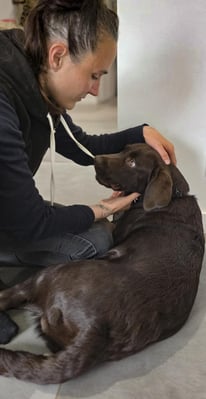 veterinary care (and/or that provided by a farrier, dentist, trainer, physiotherapist, etc.) – all these professions share a common goal: the animal’s wellbeing. This may sometimes seem utopian, but inter-professional communication is extremely important in certain cases. And the benefits of each session can thus be sustained.
How an osteopathic session unfolds
After booking an appointment – during which I ask questions to get to know the animal, to determine whether it should be referred to a vet, and to establish the reason for the consultation – I visit the client’s home to discuss matters with the owner (the animal’s lifestyle, its medical history, the reason for the consultation, etc.).
This is followed by a functional examination (both at rest and in motion) and a general health check, aimed at assessing the animal’s state of health.
Following these two examinations, I determine whether the animal is suitable for an osteopathic session or not. I may refer the animal to another professional (usually a vet) for a further examination. Next comes the palpation examination, tests covering various areas (osteoarticular, visceral, tissue, etc.), followed by the treatment, which is always tailored to the animal.
I also provide a verbal debriefing on the session so that the owner understands everything that has been done, and I offer advice for the days following the session or for the long term. A written report is also provided to the owners.
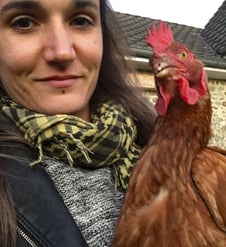 A follow-up to the session is also scheduled and carried out around ten days after my visit. It is important to know how the animal has responded to the treatment and whether it would be beneficial to adjust the post-session advice or to schedule a further session.”
Chickens, horses, dogs, cats, farm animals…
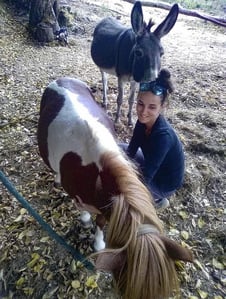
‘My patients are very diverse. As well as traditional farm animals such as goats, sheep, donkeys, pigs, cows, rabbits, chickens and geese, I also treat tortoises and guinea pigs… All your animals may well need osteopathic treatment. And, as mentioned earlier, every case is different and receives specialised, tailored attention.
I would add that, in order to provide the best possible support for my patients and their owners, I continue to develop my skills in osteopathy, as it is such a vast and fascinating subject. The field is constantly expanding in terms of knowledge. A few examples? Well, there’s the training on the tensegrity model of the body (‘tensegrity, chosen as a biomechanical model: a way of conceiving the body as a self-supporting structure in which tensions and compressions are continuously balanced’ (Patrick Chêne)), my first training course after leaving school. It opened my mind, gave me a new perspective on the body and how it functions, and was a huge step forward in my practice.
I have chosen to undertake a new training course every year: fasciae and myofascial chains, 3D visceral osteopathy, the three-module tissue-based course… We are fortunate to have an excellent post-qualification training centre in the Gard – Nymphea Protin Veterinary Osteopathy – with inspiring professionals from all over France.
All this new knowledge means that my profession is constantly evolving and enables me to better understand the sometimes complicated cases I encounter.
The same applies to new professional encounters, which allow for exchanges with osteopaths who have had to deal with – or are currently facing – the same challenges.
 A duty: Passing on knowledge
Aside from her consultations, Nymphéa aims to pass on her passion through the courses she teaches at the IFOA, the Institute for the Training of Veterinary Osteopaths.
“Yes, indeed, now that I’ve become a trainer, I enjoy sharing and passing on my experience to future osteopaths at the IFOA. After regularly travelling to the Barcelona headquarters to teach anatomy and practical osteopathy, I now teach my knowledge of practical osteopathy in Tarascon.
Sharing knowledge isn’t limited to teaching. I enjoy meeting other professionals in the animal sector or related fields, particularly through the network of Les Entrepreneuses Gardoises: meetings, round-table discussions and a particularly strong commitment to animal health, as well as other areas, whether or not they are directly related to my practice. Once again, having a strong network of trusted professionals in the animal sector is essential for me, so that I can exchange ideas, offer advice and broaden my knowledge.”
Many thanks to Nymphéa Protin for her contribution to this article.
The right address: Nymphéa Protin. Email: protin.nymphea@gmail.com, Tel: 06 65 62 30 13. Find Nymphéa Protin on Instagram.