|
"Glass is made from silica expelled by stars, lead was forged in stellar crucibles.
Glass, lead, and light form an alchemy that comes from the sky.
Cathedral builders used stained glass windows to explain theories about the sky.
Today, it is astrophysicists, who understand the language of light so well,
who are updating these theories of the universe through stained glass..." Source
|
 Marine Ventura or the “transparent partition between the artist's heart and the heart of the world”
In the beginning was Fine Arts...
"After attending the Beaune School of Fine Arts in 2005, already with the idea of moving into arts and crafts, and more specifically stained glass, I continued my training in 2007 to become a glassmaker, with a first CAP in stained glass and a second in glass decoration at the CERFAV (European Center for Research and Training in Glass Arts) in Vannes-le-Châtel," explains Marine, who continues...
From Heritage and Historic Monuments to Interior Design
“Originally from Auxerre, I had to leave my native Burgundy for the Gard region in 2009. From there, I worked for more than 13 years at Heritage and Historic Monuments, which allowed me to gain solid experience, particularly in restoration.”
 A new lease of life: the Lumivitra project
"In 2022, when I left Heritage to move into interior design, I decided to breathe new life into my career. That's how the Lumivitra project came about.
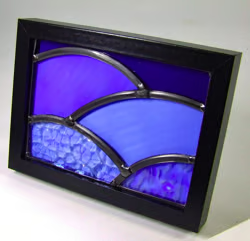
By removing stained glass from its architectural context, I transform it into a decorative object that can be more easily integrated into our modern interiors. With the concept of “stained glass as a painting,” there is no longer any need for an opening; the stained glass can be hung on the wall or placed on a piece of furniture. To achieve this, I use types of glass that do not need to be illuminated to reveal their texture, movement, or color nuances. Some are completely opaque.
However, light still plays an important role in the composition, as it is reflected to reveal all these details. This goes against the conventional idea of stained glass, but it is a way of showing that this traditional technique is a decorative art and not just a sacred art.
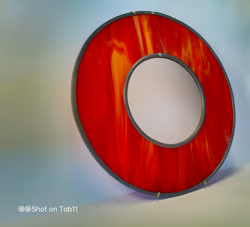
If we want to preserve the craft of art, it is up to us, as artisans, to show the public the range of possibilities with our traditional techniques by “dusting them off,” approaching them in a different way, modernizing them so that they can be used in interior design, while continuing to restore stained glass in addition to creating custom pieces".
While modern and contemporary forms often feature in her work, Marine also references the art of ancient stained glass, as in these warm-toned mirrors, a subtle reminder of her collaboration with Historic Monuments.
|
"...The master glassmakers of the Middle Ages were masters at playing with light and color through a single material: glass.
The progress of knowledge and technological advances in the 20th century have enabled the art of glass
to reach dazzling levels of creativity. This art has been enriched by new techniques and allows the greatest artists to express themselves.
New materials bring out unexpected lights: master glassmakers have become light bearers..." Source
|
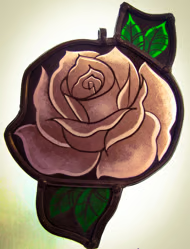
The art and technique of cutting glass, the care taken in lead jointing... Tell us more...
"When creating a stained glass window, it all starts on paper with the creation of a model where we determine the final design.
Then, based on the full-scale model, paper templates are cut out: each template corresponds to a piece of glass. Much like a seamstress, I place this template on my glass plate to cut the desired shape, carefully following the outline.
Once the pieces of glass have been cut, it's time for assembly. Like a giant jigsaw puzzle, the pieces of glass are fitted together using lead joints to form the stained glass window. Tin solder is applied to each lead intersection, on both sides, to hold the whole network together.
The final step is to seal the stained glass window on both sides to strengthen it and make it watertight. To do this, it is coated with a mixture of linseed oil and Meudon white, which seeps between the lead and the glass. As it dries, a waterproof seal is formed".
|
“Stained glass is the wildest, most unpredictable form of art. Stained glass is nothing but madness, metamorphosis,
illusory blossoming, a play of wild seaweed in a river of light” (Bernard Tirtiaux, master glassmaker, theater actor, singer, and Belgian writer).
|
Based in a workshop in Pont-Saint-Esprit, Lumivitra nevertheless has a presence throughout the department. Craft markets (such as the Journées des artisans d'art, for example), shops (notably its partnership with La Petite Boutique, 4 rue du jeu de paume in Aiguèze), trade shows (such as Nimagine, from November 8 to 16, 2025) and galleries (Atelier-galerie Label LN, in Saint-Quentin-la-Poterie during the Ateliers en fête on December 13 and 14, 2025).
The right address: Lumivitra, Impasse Latour, Pont-Sant-Esprit. Contact: lumivitra@hotmail.com, tel: +33 (0)6 71 18 95 76. Find Lumivitra on Instagram and Facebook. Lumivitra in Aiguèze, on the first floor of La Petite Boutique, 4 Place du Jeu de Paume.
The Label LN workshop-gallery, 4 rue du docteur Blanchard in Saint-Quentin-la-Poterie, atelier-label-ln.com, label.ln30@gmail.com.