|
AILERONS? Association Ichtyologique pour l’Etude, la Recherche et l’Observation dans la Nature des SélaciensIchthyological
(Association for the Study, Research and Observation of Selachians in the Wild)
|
 Scientific and educational projects, talks, sea trips
Through their research, numerous field missions and awareness-raising activities to showcase their work, the association’s members work day in, day out to defend an ecosystem weakened by human presence and environmental pollution.
“We offer talks and presentations on various topics. It really depends on demand and who within the association is giving the talk, but generally we explain what sharks and rays are (evolutionary history, cartilaginous fish, the difference between superorders, phylogeny…), then we provide an ‘overview’ of the species found in the Mediterranean, the threats they face and, finally, the solutions and our actions,” explains Marine Loisel, vice-president of the association.
|
Did you know? Despite appearances and the relative rarity of sightings,
the Mediterranean Sea is home to a wide variety of chondrichthyan species
which include the elasmobranch family (sharks and rays)
& holocephalus (chimaeras)
(commonly known as cartilaginous fish).
According to the International Union for Conservation of Nature (IUCN),
73 species of cartilaginous fish are considered to be resident in Mediterranean waters,
including 40 species of sharks, 32 species of rays and a single species of chimaera...
|
 Want to get involved?
The AILERONS association operates on several levels through a range of programmes:
At Sea
- Grand large (departing from Port Camargue to explore the open sea and the animals that live there), a project training students & volunteers into observing & collecting DNA sample from blue skin sharks, learning more about Mediterranean population genetics. In this context, the Ailerons association organises once a year Open Ailerons, aimed for recreational fishermen to learn more about the blue skin shark.
- Diable de mer (Devil fish), the association’s flagship project named after an endangered species, the sea devil, the only ray in the Mobulidae family found in the Mediterranean.
As part of this project, a highly qualified team sets sail every summer on a catamaran off the coast of Corsica to study Mobula mobular and fit tags to track individual animals (photo: Sea Devil © Benoît Verdeille)…
- Pel-Med, a study aimed at improving our understanding of the basking shark, which is classified as endangered in the Mediterranean by the IUCN (International Union for Conservation of Nature): The aim of Pel-Med is to contribute to the implementation of recommendations and proposals for concrete management actions along the Mediterranean coastline which, in the future, may help to safeguard the species, notably through improved management.
 On land
On land, the Education division enables the association to raise public awareness of these little-known animals. It is worth noting in this regard that over 53 per cent of chondrichthyans are threatened with extinction according to the IUCN.
Finally, ‘Agir à mon échelle’ (At my level) enables users to take action for the conservation and protection of Mediterranean sharks and rays.
‘As the association is open to everyone, anyone wishing to get involved is welcome, regardless of their background.
As you can see, the tasks on offer are varied and depend on the time of year: running a stall, school visits, DNA sampling of blue-skinned 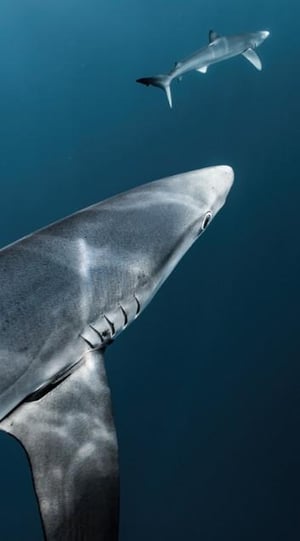 sharks, fundraising, creating communication and educational materials, and taking part in scientific expeditions’ (photo©Benoît Verdeille)...
‘Each project has its own theme and helps to address a wide range of issues,’ Marine Loisel is keen to point out.
‘It’s worth noting that AILERONS involves more than 60 days in the field each year, the first 10 tags fitted to study sea devils, more than 3,000 sightings of elasmobranchs (a class of fish characterised by a cartilaginous skeleton in adults, which includes sharks (photo © Pierre Leo Paul), rays and chimaeras) recorded, three new elasmobranch sites discovered in France, and the creation of the first atlas of sharks and rays in France in collaboration with the Natural History Museum,’ adds the vice-president.
‘As for internal communication, all information is shared via WhatsApp chat groups, as well as a newsletter and a Facebook group.
To join us, everything is handled via Helloasso. Once membership is complete, new members receive an email with information to help them get off to a good start in the association. It’s quick and easy!’ she emphasises.
Collaboration with the Elasmed research institute and the Sentinelles de la Mer Occitanie network
The Elasmed laboratory aims ‘to collect and make use of multi-user opportunistic observation data (from diving, recreational boating, fishing and fish stalls) on rare and little-known areas. This data is made available to scientists and reported to Sentinelles de la Mer Occitanie, particularly in national databases via the National Inventory of Natural Heritage (INPN).’
The AILERONS association works in close collaboration with the Sentinelles de la Mer Occitanie (SDLMO) network, which monitors the coastline both  above and below the water’s surface. Since its creation in 2015, the Sentinelles de la Mer d’Occitanie network, coordinated by the CPIE Littoral d’Occitanie (formerly CPIE Bassin de Thau), ‘brings together organisers of participatory science programmes focusing on the sea and the coast in the Occitanie region’.
The association and the Sentinelles de la Mer Occitanie work together on various initiatives such as the Alien programme, which highlights that ‘biological invasions in the marine environment are considered a global threat to native species, the economy and human health… and one of the five causes of biodiversity loss, alongside habitat destruction, the exploitation of natural resources, climate change and pollution (IPBES 2019 report)’ (bioobs.fr, Database for the Inventory of Underwater Observations).
What else? The diving club
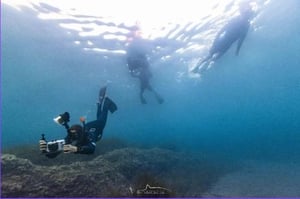
To explore the underwater world up close, there’s nothing quite like diving in the Mediterranean sea. Founded in 2023, the diving club offers introductory dives and dives to a depth of 12 metres. A special moment for a unique 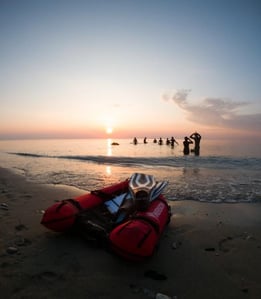 experience in the heart of the Mediterranean (photo © Marine Massa).
How to support the AILERONS association
- You can make a donation or a micro-donation (66% off your income tax return) to support the association’s efforts to protect sharks and rays in the French Mediterranean.
- Come & visit the shop, another of the association’s flagship initiatives, enables it to spread its message through a range of books, themed clothing and more.
- Send comments about your sharks or rays observation through Elasmed.
- or just become a volunteer.
Many thanks to Marine Loisel, Vice-President of the AILERONS Association, for her contribution to this article and for the documentation and images provided.
The right address: Association AILERONS, Université Montpellier 2, 34090 Montpellier. Tel: 06 16 39 81 30. Find the AILERONS Association on Instagram and Facebook.
To find out more about the diving club, write at contacts@asso-ailerons.fr.
The AILERONS Association is collaborating on the Mona’venture board games (read our paper MONA’ venture, des jeux de société sur l'environnement).