


FR – Under her artist name, Pée, Perrine takes us on a pastoral stroll through the heart of the floral world. Bright settings and highly photogenic subjects feature in her colourful, vibrant paintings.
Perrine’s inspiration? The local flora of the Cévennes and Mediterranean landscapes in general, with occasional forays into the unique and fascinating world of flowers and other plants.
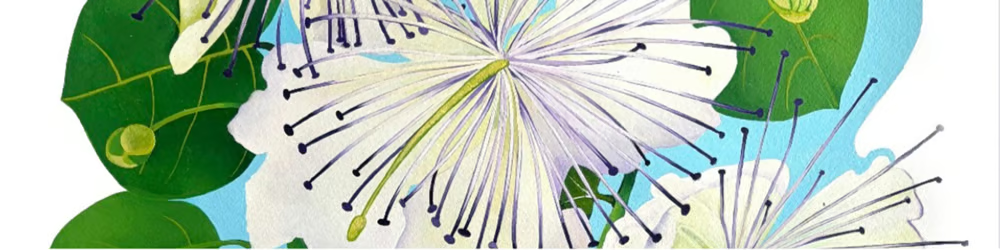
Met during her exhibition ‘Butinerie’, held at the Medieval Garden in Uzès from April to May 2026, Perrine enchants us with her refreshing compositions.
Understated, reminiscent of traditional herbariums in some cases, and 100% colourful in others, the paintings discovered at the Medieval Garden take us on a journey and immerse us in nature, where the wild side of the undergrowth and footpaths soothe and charm…

A Floral Encounter
Hello Perrine,
Could you tell us more about your life before becoming Pée…
Well... I have been painting since my childhood in Saint-Quentin-la-Poterie. And it was for the sake of art that I subsequently moved to Paris, where I lived for 20 years, initially enrolled on a Master’s degree in General and Comparative Literature at the Sorbonne.
It was in Paris, in fact, that I began this series, with Hymen, an acrylic on canvas depicting flowers of virginity haloed in vital blood. It was linked to three female archetypes of the same format.
|
A language of feelings and love whenever I wear a flower, give one to another, or receive one. A lover’s red rose, a bouquet thrown at a wedding, a child’s gift to their mother, a dried flower, a funeral wreath, the floral world conveys our feelings.
|
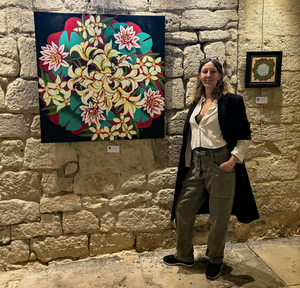 I completed Hymen upon my return to my homeland, in Saint-Quentin-la-Poterie, where the lushness of the flowering vegetation was a source of joy and inspiration. To contemplate, to understand the structure of a species… I wanted to bear witness to this simple joy of a nature that is abundant and ever-renewing, like an ode to life.
You are mainly inspired by the flora of the Gard and Cévennes regions, but that is not all. How do you go about choosing your subjects and themes?
Classical literature has always permeated the motifs of my paintings. Figures of women and deities, since antiquity, have been subjects of exploration and expression.
The feminine and the floral theme have been intrinsically linked since antiquity, emerging in the Middle Ages as a symbolism that has infused the fabric of our narratives.
The flower, an analogy for woman—as seen, for example, in The Romance of the Rose (Le roman de la rose) —still inspires vaudeville and film comedies.
Some paintings are herbarium-style, others richly coloured; what techniques do you use? Which paints are best suited to your work (water-based for watercolour, acrylic, etc.)?
I paint with acrylics, using a brush, more or less diluted with water, on paper weighing between 180 and 300 grams. For botanical drawings, as with my compositions, I start with an outline in HB pencil, which I then clean up and cover with gesso, before applying layers of acrylic paint.
We discovered you through the ‘Butinerie’ exhibition at the Medieval Garden in Uzès. How do these collaborations come about?
It was at the opening of the exhibition at Les Truffières in Uzès that Marylène came to appreciate my work. Moreover, the floral theme fitted perfectly with the bucolic setting of the medieval garden.
My series are like threads that intertwine and weave the fabric of my pictorial expression, always echoing our cultures, from antiquity to the present day, where technology seems to disconnect us from the deeper meaning of our gestures and words, which nevertheless stem from the depths of our collective unconscious.
Since our meeting, I have produced the botanical drawings for the Pays Cévennes, notably the herbs that it seemed obvious to include in the exhibition. The caper bush thus pays tribute to the medieval garden, which has managed to maintain and propagate—a true feat—a superb caper bush. As for the two daisies illuminated with gold leaf, the last in the Butinerie series, they remain alongside Hymen, owing to their virginal symbolism, as established by our medievalist, Michel Pastoureau.
Any plans for painting courses or workshops, or perhaps field trips to better understand your approach to nature?
For the moment, I am not offering any training or workshops, but some of my botanical drawings of wildflowers, on display in the garden until 10 May, can also be seen on the display boards along the educational trail near the thermal baths at Allègres-les-Fumades.
Many thanks to Perrine Busquet for her contribution to UzEssentiel.
The right address: Follow Perrine Pée on Instagram. Contact: perrinebusquet@gmail.com.