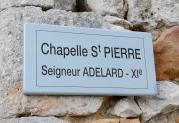
 Probably based on a "pre-Christian sanctuary in the middle of the mountain" (monsmediolanum) - which probably gave its name to the village La Masmolène (monsmediolanum giving mon molena), the origins of the Romanesque chapel, which was once known as the chapel of the Tower, date back to the 11th century.
The many lives of the chapel
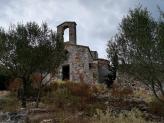
The chapel has a beautiful, luminous apse, and lived through troubled times throughout its existence. Partly destroyed during the Albigensian War, rebuilt in the 13th century, it was used as the corner tower of the new rampart at the end of the 14th century, then as a granary or salt storehouse, and even as a mill, before undergoing further heavy destruction under Richelieu in the early 17th century.
At the end of this century, additions to its architecture are noted, such as these two small windows, now condemned at the beginning of the 18th century, two vaults at the entrance, a pulpit... As for the bell tower that we can see today, it dates from this period, and gives a religious ensemble that did not change from 1852 onwards.
 The association for the restoration of the Saint-Pierre chapel
Thanks to the intervention of the Association for the Restoration of Saint Pierre's Chapel, founded in 1982, the chapel was restored at the beginning of the 1980s.
Good to know : The bell of the chapel was requisitioned during the manufacture of Napoleon Bonaparte's cannons. The one that replaced it in 1824 joined the new village church, Saint-Pierre et Saint-Michel, when the Saint-Pierre chapel was desacralized in 1860.


