



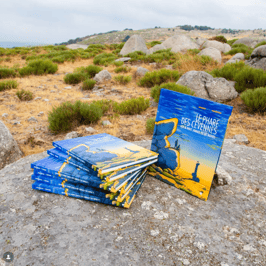
FR – A conversation with scriptwriter Philippe Donadille, writer of the dialogue and screenplay for the graphic novel Le phare des Cévennes qui n’avait jamais vu de navire (The Lighthouse in the Cévennes That Had Never Seen a Ship), published by Alcide in collaboration with illustrator Benoît Pouydesseau.
 Through the Comic Strips
Introduction
Passionate about writing and cinema, Philippe Donadille founded a collective through which he has produced and directed several films, ranging from short films to feature-length films – a diverse body of work that undoubtedly reflects his love of storytelling.
Adapting stories into comic book scripts, he published his first graphic novel, Djemnah, les ombres corses (Delcourt), in 2022, with artwork by Patrice Réglat-Vizzavona: “a publishing adventure that I recount in a diary available on the Bubble BD website, alongside a documentary web series offering a behind-the-scenes look at the creation of this graphic novel,” Philippe Donadille tells us.
|
A key figure on the regional literary scene, Alcide Editions is celebrating its 20th anniversary in 2026
|
 Le phare des Cévennes qui n’avait jamais vu de navire
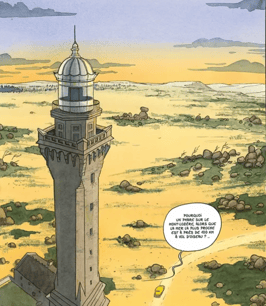
The scriptwriter’s second album, set this time in the Cévennes of his childhood, Le phare des Cévennes qui n’avait jamais vu de navire, ‘features an eccentric character, Archibald, who, in the 1950s, built a replica of a Breton lighthouse (the Eckmühl Lighthouse) on the Mont-Lozère plateau’.
Let’s talk about Mont Lozère (the Occitan ‘mont Losera’). One of the region’s most iconic mountain ranges, rising some 100 km from the Mediterranean and dominated by the Finiels at 1,699 m, Mont Lozère is also a hero in his own right in the comic book by the duo comprising Benoît Pouydesseau, the illustrator and watercolourist, and the scriptwriter. A setting that couldn’t be more cinematic, 100 per cent wild and… quintessentially Cévennes, for a story that aims to make us think, starting with the very first question that springs to mind: Why is there a lighthouse so far from any sea? What lies behind this enigmatic structure? “Questions and numerous mysteries that our story—which navigates between childhood nostalgia, family ties, ecology and History with a capital H…—presents to readers over the course of its 112 pages, urging them to turn the pages to discover the full story,” explains the scriptwriter.
 How did Le phare des Cévennes qui n’avait jamais vu de navire?
“After a picture book that showcased my mother’s homeland, Corsica, I wanted to explore my father’s homeland. Mont-Lozère is a fabulous setting. Nature reigns supreme there. The area is relatively uncrowded; it remains a wild landscape. I love to recharge my batteries there as often as possible. So I wanted to bring this setting to life and explore some of its natural and historical aspects.”
How did you meet Benoît Pouydesseau and decide to work with him on this comic?
“Quite simply through social media. I’d spotted his work on Instagram, so I got in touch with him. We did some test sketches to see if we were a good fit. A comic of this kind takes several years to complete, so it’s best to get on well and make sure we share the same vision for the project…
He was won over by my story and I by his artwork. I take my hat off to him, because taking on a project like Le phare des 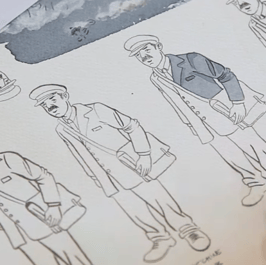 Cévennes – with over 100 panels, all in watercolour, for a debut album – was quite a challenge for someone who’s self-taught in drawing!”
What were the different stages in the creation of this comic?
“Personally, I know the locations off by heart, so I didn’t really do any location scouting on Mont Lozère. However, I provided Benoît with a huge collection of images so he could get a feel for the places. He’s not from the region; he’s based near Bordeaux. So he was absolutely swamped with my photos!
I provided him with a script broken down by panel. In other words, I describe the setting, the action and the dialogue for each panel. He then produces a storyboard (a very basic first draft of the drawn panel). Based on this, I comment on his panel layout and revise my dialogue. He then moves on to the pencil sketch, which means he draws the final panel in pencil...
This is followed by further discussions and adjustments before moving on to inking, which will permanently set the panel’s drawing. He finishes by adding colour with watercolours.”
|
About the illustrator, Benoît Pouydesseau: “Travelling the world with a sketchbook in hand and a rucksack on his back,
Benoît Pouydesseau has visited both distant horizons and the roads of France,
as exemplified by a rugged cycle journey across Lozère. These journeys have instilled in him
a deep awareness of the richness of nature and the beauty of our local landscapes,
a duality that now permeates the pages of this graphic novel. After starting out in illustration
and short comic strips, his work was honoured with the Jury’s Special Prize at the 50th anniversary of Fluide Glacial.
Building on this experience, he has produced his first graphic novel
in which escape is as much an inner journey as it is a geographical one’ (Editions Alcide).
|
“In short, Benoît redraws almost every panel four times, from the storyboard stage right through to the colouring stage. We’re in constant dialogue throughout the process. It is from this dialogue that the graphic novel emerges. We mutually enrich our visions of the story. You can see why it takes years…
For the characters, I provide an initial cast list, along with a physical and psychological description. I suggest actors or public figures so that Benoît can get an idea of their appearance. For the settings, my photo database serves as a basis. He then makes all of this his own to create the protagonists and settings.”
Are you already thinking about the next album that will captivate you and take you to new horizons?
“I have several projects underway with various illustrators. Some are set in the Cévennes again, others aren’t. But it’s hard to say which one will come to fruition next.
Le phare des Cévennes is my second album, following Djemnah, les ombres corses”…
Would you like to add a comment?
“We’ve produced a few video clips that tell you a bit more about our album; you can find them here. I’d be delighted to chat with any readers who come along to my event at the Maison de la Presse on 19 September!”
The right address: Follow Philippe Donadille and Benoît Pouydesseau on Instagram.