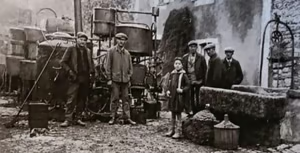
 'At the start of the last century, few people owned a camera to capture everyday life. Yet a few images have stood the test of time and now allow us to rediscover the village of yesterday' comments Manu Raga.
'Do remember that not so long ago, Arpaillargues had only 250 inhabitants and didn’t get running water until… 1957. But since the last century, the village has grown considerably and is now home to some 1,200 inhabitants, including many children, who are gradually reviving the village school in their own way…
The photographs selected, often seemingly simple, are in reality true treasures. They bear witness to an era, a way of life and an identity that have shaped our village… helping to forge links between generations, between those of yesterday and those of today. As for local shops, let us recall, for example, the Dalmazie grocery store, the Croze or Artigas bakeries, the sale of milk straight from the milking at the Fontanille or Mazel farms, the 1930s still of the local distiller’...
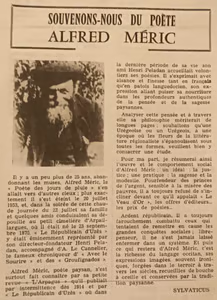
Already through his Facebook page ‘Arpaillargues-et-Aureilhac mon village’, Manu Raga, the local correspondent for the weekly newspaper Le Républicain, was working to shed light on this history of the past, on these old and forgotten trades, on this train station that closed its doors in 1936, on these ceremonies that brought together the bride and groom and the parishioners in a farmyard or in front of the church…
'Among the iconic figures of the village whom I wished to present in my exhibition, we might mention ‘the peasant poet Alfred Méric, founder of the magazine L’Arpagus’.
“Expressing himself with ease and finesse in both French and the Languedoc dialect, his style, drawing its inspiration from the authentic depths of peasant thought and wisdom, is an inexhaustible source of human experience and culture,' tells us Manu Raga…
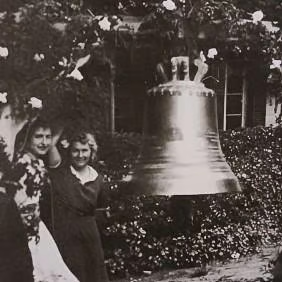
Another photograph in the exhibition, this one dating from 1946, similarly recalls a historic moment in Arpaillargues: the recasting of the church bell in Annecy and its reinstallation, following its christening, which took place during a grand ceremony in the grounds of the Maison Béraud, where it was given the name Gabrielle by its godmother, Mademoiselle Béraud herself.
As we wander through the church’s temporary exhibition, we find ourselves transported to the heart of those bygone days; we sit alongside the elders on the village benches, we imagine their conversation, we stroll along the banks of the river Deysennes (now known as Les Seynes)…
|
Another memory? ‘The Galhard wheat mill, a witness to the village’s industrial and artisanal development,
whose history spans over eight centuries…
First mentioned in 1200 in the inventory of the Archives of the Bishopric of Uzès…
from 1824 it housed a factory producing iron sheet boilers and steam engines, and,
from 1833, a silk spinning mill.
Changing its name in 1894, the mill came under the ownership of the Chalier family
and added an oil mill to its operations from 1925'…
|
Although the project initially focused on colour photographs, Manu Raga soon expanded his research, asking both the older and younger generations to share their memories. Ultimately, the village’s collective memory is being revived, with some people rediscovering long-lost ancestors, piecing together their memories from a single detail, or recalling an anecdote.

From the ‘votive festival, the beating heart of the village, to the games of pétanque on the Place du Pouzet, from the Arpagus football team, which in the 1930s had set up its headquarters at the Café de l’Univers, to the makeshift cinema opposite the bar until the 1970s, it is for all this that I love to search, again and again, for fragments of our village’s history—a long-term endeavour, certainly, but such a rewarding one'…
The children in the photographs are now grandparents or have started a dynasty of craftsmen… The school photos and group shots remind the older generation of immortalised moments from their youth…
The right address: Manu Raga’s Facebook page ‘Arpaillargues-et-Aureilhac mon village’.