 'My life has, after all, always revolved around gastronomy… After 10 years in the world of wine (notably at Château de Campuget and as a sommelier on cruise ships), I began to take an interest in the world of coffee following a trip to Jordan. Whilst camping in the heart of the desert, I had the chance to taste traditional coffee, prepared in a makeshift sand fire pit. It was a revelation.
I then decided to take the plunge and train under master roasters in Le Havre – a city with a history of coffee importation and roasting dating back to the 18th century (you can actually find some coffee plants in the greenhouses of the Hanging Gardens) – as well as in Bordeaux, Aix-en-Provence and Paris.
At the same time, I undertook training in every area of the coffee industry, such as the essential skill of trading, aided in this by my background in viticulture. In the shop, Allan supported me and helped me take the plunge into entrepreneurship when we decided to take over the business, with the support of Initiative Gard (read our paper).’
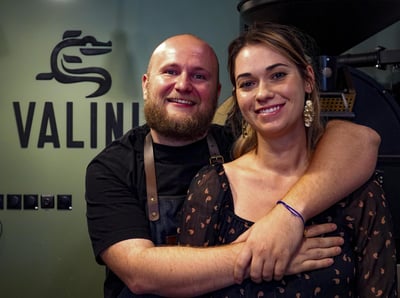 Valini: a team effort
'Valini is indeed a team effort, but above all a family project. My wife and I designed Valini to reflect who we are, to forge connections, to bring our passion for coffee to life and to preserve the unique identity of each producer’s coffee'.
Valini: the choice of speciality coffee
'We therefore chose speciality coffee, where the producers’ work is given its due recognition – from planting to harvesting – and where the coffees’ very specific aromas reveal their full character.'
Today, a speciality coffee is defined according to the following criteria… which enable us to select coffees grown and harvested under specific conditions, with very few defects and a beautiful aromatic complexity… Traceability, country of origin, roasting… all hallmarks of superior quality, allowing you to enjoy a coffee with aromatic complexity in the best possible conditions.
And then, speciality coffee also reflects Rudy’s commitment to doing his bit for the planet. Voyages from distant lands on sailing boats, deliveries to Nîmes by bike… all with a view to reshaping the image of coffee.
|
The Valini logo? We wanted to preserve the brand’s roots,
whilst adding our own touch.
Celadon-green sachets, echoing the shop’s colours,
crocodile-scale-style embossed edges, informative labels
(name, origin, flavours, preparation tips…),
all created in collaboration with Studio 30, a local company.
|
Single-Origin coffees
Brazil Bacana from the Minas Gerais region in south-eastern Brazil, ‘with notes of chocolate, hazelnut and almond’ (the name Bacana means ‘cool’ in Portuguese),
Colombia Huitaca, named after the rebellious goddess of Muisca mythology, from the Huila region in south-western Colombia, with refreshing ‘notes of citrus, acacia and chocolate’,
Santa Fe, a water-decaffeinated coffee from the Chiapas region in south-western Mexico, a gourmet coffee with notes of biscuit, praline and chocolate,
Peru Timbuyacu Single Origin Coffee, from the San Nicolás region in northern Peru, 'a rich and balanced coffee with lovely depth, a chocolatey base, accompanied by notes of ripe cherry and strawberry, lending a gentle fruity touch'.
Bombe, from the Sidama region of Ethiopia, in the south-west of the country, with notes of red berries, jasmine and oranges.
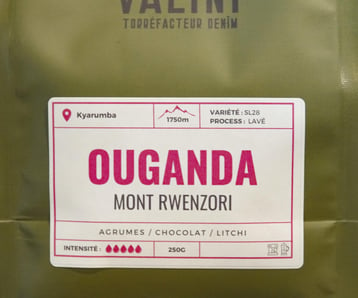 Single-origin and blended coffees
The Blends represent a skilful combination of flavours and origins.
Whilst we find the Santa Fe and the Bacana, the Timbuyacu and the Huitaca, we also come across the Croco, inspired by Brazil and Ethiopia.
As for the Rwanda Baho, from the country’s western province and the Lake Kivu region, this coffee grows on the slopes of the Rwenzori, a spectacular mountain range known since ancient times as the ‘Mountains of the Moon’.
This coffee is delicate and modern, both fruity and refined, offering the juicy sweetness of melon, the vegetal elegance of green tea and a sweet hint of grape on the finish. The cup is silky, balanced and highly aromatic, with a lovely length…
|
The little bonus? The chance to create your ‘very own coffee’
by combining several varieties and origins.
A unique and… personalised flavour!
|
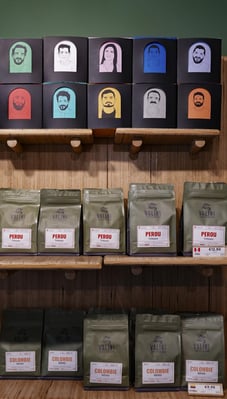
What about speciality coffees?
‘Ah, speciality coffees – another fascinating subject! These are extremely limited productions, with only a few kilos available worldwide, of the highest quality and with organoleptic notes that are inevitably exceptional and inimitable.
We’re talking here about coffees such as the Geisha from Panama, introduced to Central America in the 1960s but originally from Ethiopia – undoubtedly the rarest and most expensive coffee in the world.
Coffee thus takes us all over the world. And what we love most of all is setting out to discover the producers and their estates during our exploratory trips. In the case of Geisha, we met Rachel Peterson, owner of Hacienda La Esmeralda (whose origins date back to the 1940s), who took over the reins of the family farm that her father had bought in the late 1960s. And since 2024, she has been working to highlight the undeniable qualities of this coffee, with its aromas of jasmine and stone fruits…
Another example? Pepe Jijon’s La Soledad, from Finca Soledad in Ecuador, with its delicious flavour blending honey, lemongrass and medlar, originating from the Intag Valley, where the soil is particularly well suited to coffee cultivation…’
|
Gold medal at the Gard Gourmand competition,
two-time regional champion in the ‘Best Espresso in France’ category,
two-time runner-up in the ‘Best Espresso in France’ category…
|
Valini’s collaborations
Valini regularly works with chocolatiers such as Mes Chocolats (Alès and Uzès – read our paper), Michelin-starred restaurants (such as the one-star Monique in Calvisson), and pastry chefs… 'It’s a real pleasure to collaborate with other professionals in the culinary arts. It allows us to explore new combinations, meet different expectations and, in a way, push ourselves further.
|
'A shared commitment to a job well done,
an exceptional coffee that we elevate in three gourmet creations:
ganache, chocolate bar and ice cream!' Alfonso Cannarozzo, Mes Chocolats
|
What’s more, we train staff at certain hotels and restaurants to teach them how to prepare and serve coffee. In that respect, it’s almost like tasting a fine wine or the tea ceremony and… it’s quite an art form!'
Tell us about your workshops?
'We run tasting workshops lasting between 1½ and 2 hours, for 2 to 6 people, on Saturday evenings, by booking only – workshops which have proved a great success. During these sessions, we invite everyone to delve into the history of coffee, from its origins to its cultivation, following the coffee beans… from the tree to the cup, so to speak.
It’s an immersive, fully sensory experience in the world of aromas, with a touch of cupping, so you can taste coffee like the pros.'
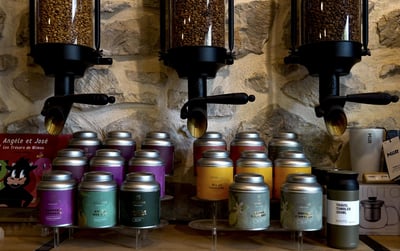 To complete Valini’s offering…
“To round off our offering, we wanted to expand our range of flavours by introducing our own brand of tea, Osmose… Just as international as our coffee range, the carefully selected Osmose range promises a journey that is as much about taste as it is about culture for tea lovers, exploring the history of plantations, aromas and brewing rituals. ”
Many thanks to Rudy Aubert and his wife for their collaboration with this article.
Photographs©serra.gilbert.
The right address: Valini, 23 Avenue Carnot, 30000 Nîmes. Open on Mondays, Tuesdays, Thursdays and Fridays from 9.30 am to 12.30 pm and 2 pm to 6 pm, and on Saturdays from 9.30 am to 12.30 pm. Contact: Tel 04 30 67 40 66 or contact@valini.fr. Find Valini on Instagram and Facebook.